Product Overview
Industrial shot blasting machines provide mechanical surface conditioning for metal components prior to coating, welding, or assembly. The system uses heavy-duty direct-drive or belt-driven centrifugal blast wheels to throw steel shot, steel grit, or stainless steel cut wire against workpieces at velocities up to 80 m/s. This removes mill scale, rust, welding slag, and core sand while inducing compressive residual stresses to improve fatigue resistance.
-
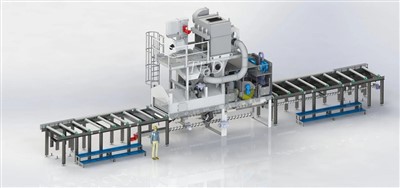
![Roller Conveyor Shot Blast Machine]() Roller Conveyor Shot Blast MachineThe use of roller conveyor shot blast machine can effectively clean the surfaces of metal plates, profiles and composite structures. The TED roller conveyor shot blasting machine adopts a horizontal roller conveyor and is compatible...view more
-
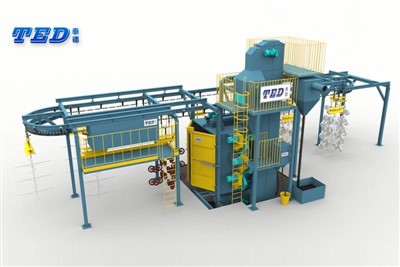
![Continuous Hook Shot Blasting Machines]() Continuous Hook Shot Blasting MachinesThe continuous Hook Shot Blasting Machines represents a particularly versatile solution for the treatment of parts hanging individually or in clusters to the hooks (with motorized translation) of a monorail overhead conveyor.view more
-
![Hanger Type Shot Blasting Machine]() Hanger Type Shot Blasting MachineUsing a hanger type shot blasting machine, the workpiece is moved through two sliding cranes on a rail. Customized hanger type shot blasting machine is a particularly versatile solution for handling parts which is suspended...view more
-
![Wire Mesh Belt Shot Blasting Machine]() Wire Mesh Belt Shot Blasting MachineTed has developed a set of wire mesh belt shot blasting machine for surface treatment (roughening, glazing, calendering) of marble tiles, natural marble or block slabs, granite, cement tiles, chain paving, curbs, etc. The workpieces...view more
-
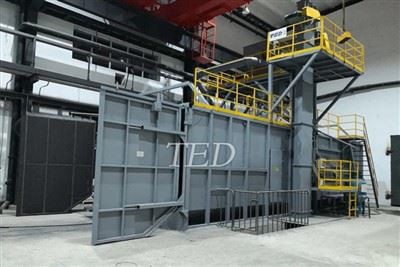
![Trolley Type Shot Blasting Machine]() Trolley Type Shot Blasting MachineThe trolley type shot blasting machine is used to solve the shot blasting cleaning of large and medium-sized ductile iron and gray cast iron parts, removing sand, rust, oxide skin, dirt, etc. on the surface of the workpiece, making the...view more
-
![Anode Shot Blasting Machine]() Anode Shot Blasting MachineAnode shot blasting machine, the anode claw can be shot blasting. After cleaning the workpiece can remove the residual surface of the workpiece electrolysis material. Anode shot blasting machine is a single hook-type shot blasting...view more
-
![Crankshaft Shot Blasting Machine]() Crankshaft Shot Blasting MachineCrankshaft shot blasting machineis a round of special shot blasting equipment. Through the shot blasting, not only can remove the wheels on the surface of the corrosion, oxide, etc., can also reduce the workpiece internal stress,...view more
-
![Shot Blast Machine for Wheel Set]() Shot Blast Machine for Wheel SetWheel hub special shot blasting machine is a round of special shot blasting equipment. Through the shot blasting, not only can remove the wheels on the surface of the corrosion, oxide, etc., can also reduce the workpiece internal...view more
-
![Wheel Hub Conveyor Shot Blast Machine]() Wheel Hub Conveyor Shot Blast MachineWheel hub shot blasting machine, one type of roller conveyor type stone shot blasting machine, the need to clean up the hub of a one-time through the blast. Not only can remove the scale of the workpiece surfaceview more
-
![Concrete Road Surface Shot Blasting Machine]() Concrete Road Surface Shot Blasting MachineConcrete shot blasting machine for the highway,road,construction and maintenance, development and design and manufacturing. Its scope of application is as follows:view more
● Asphalt pavement anti-skid treatment The impact of roughness on... -
![Manipulator Shot Blasting Machine]() Manipulator Shot Blasting MachineThe manipulator type shot blasting machine is a efficient machine developed according to market demand.Manipulator type shot blasting machine consists of double work position.view more
-
![Vertical Steel Plate Shot Blasting Machine]() Vertical Steel Plate Shot Blasting MachineThe vertical plate steel shot blasting machine means the processing type that performs surface shot blast for rust removal, strengthening or sand surface treatment on the steel plate before they are processed . After the steel plate is...view more


Types & Configurations
Tumbling Belt Machines (Tumblast):
Continuous rubber or manganese steel endless belts tumble medium-to-high-volume batch parts (forgings, small castings, stamped components) to expose all surfaces to the blast stream.
Roller Conveyor Machines:
Plates, structural H-beams, and pipes pass continuously through a horizontal blast tunnel on driven roller tables, integrated directly with automated pre-heating and painting lines.
Table Type Machines (Rotary Table):
Workpieces sit on a rotating turntable or satellite fixtures, suited for fragile or complex components that cannot withstand tumbling impacts.
Hanger Type (Monorail) Machines:
Parts hang from overhead conveyor hooks through a closed-loop blast cabinet, handling mixed batches of large, heavy, or irregularly shaped fabrications.

Loading & Sealing: Workpieces enter the blast chamber through multi-stage labyrinth rubber seals designed to contain rebounding media.
Centrifugal Acceleration: Abrasive gravity-feeds from an upper storage hopper through an adjustable control cage into the spinning impeller, where centrifugal force accelerates particles outward through high-chrome alloy blades.
Impact & Cleaning: High-velocity media impacts the metal surface, fracturing scale and oxides while plastic deformation cleans surface imperfections.
Separation & Recovery: Spent abrasive, dust, and debris fall through perforated floor plates into a recycling screw conveyor, moving to an air wash separator that removes fines before clean media returns to the storage hopper.
Key Features
High-Chrome Blast Wheels:
Turbine blades cast from high-chromium alloy (HRC >= 62) paired with dynamically balanced impellers, minimizing vibration and operating noise under continuous heavy loads.
Full-Flow Air Wash Separator:
Multi-stage cascading baffle system separates spent abrasive from metallic fines and dust, maintaining consistent abrasive size distribution and surface finish profiles.
Cast Manganese Protection:
High-impact zones inside the cabinet utilize replaceable high-impact manganese steel liner plates that work-harden under continuous media impact.
Cartridge Dust Collection:
Reverse-pulse pneumatic cleaning systems equipped with nanofiber filter media maintain particulate emissions below 5 mg/m3.
Applications
Foundry & Forging:
Stripping burnt-on core sand, parting line burrs, and heat-treatment scale from ductile iron castings and steel forgings.
Structural Steel Fabrication:
Descaling hot-rolled plates and structural profiles to achieve an Sa 2.5 cleanliness grade and a 40 to 75 um anchor profile prior to shop-primer application.
Automotive Manufacturing:
Shot peening leaf springs, gears, connecting rods, and crankshafts to introduce compressive stress and increase cyclic fatigue life.
Pressure Vessel Construction:
Removing rust and mill scale from large cylindrical tanks and pipe spools prior to non-destructive testing (NDT) and anti-corrosion coating.
Plate Cutting: CNC laser and plasma cutting systems process structural steel plates and wear liners with dimensional tolerances within +/- 0.2 mm.
Weld Integrity: Main structural blast cabinets undergo continuous wire-feed welding by certified operators, followed by ultrasonic testing (UT) or magnetic particle inspection (MPI) on high-stress frame joints.
Dynamic Balancing: Rotor assemblies and blast wheel wheels undergo multi-plane dynamic balancing at 3,000 RPM to limit vibration displacement below 0.5 mm/s.
Surface Treatment: All carbon steel fabrications receive abrasive grit blasting to a Sa 2.5 standard followed immediately by an industrial epoxy primer application prior to assembly.
Electrical Compliance: Control panels are built using standardized industrial automation components, wired to applicable international safety standards with interlocked safety limit switches on all maintenance doors.

Customization & OEM
Chamber Dimensions: Cabinet width, height, and length modified to fit oversized or long-length fabrications.
Automated Material Handling: Custom loading hoppers, cross-transfer chain conveyors, and unloading vibratory troughs integrated into existing factory lines.
Wheel Positioning: Multi-axis wheel configurations recalculated via computer simulation to eliminate blast shadows on complex geometries.
Filtration Upgrades: High-temperature or explosion-proof dust collection configurations specified for aluminum, magnesium, or reactive alloy processing.
Selection Guide
Batch vs. Continuous: Choose tumbler or table types for discrete batches of small-to-medium parts; select roller conveyor or monorail configurations for continuous in-line production of structural profiles or large weldments.
Workpiece Weight & Fragility: Thin-walled or brittle aluminum components require lower velocity throw rates and cushioned rubber belt tumblers to prevent impact damage.
Abrasive Type Selection: Use high-carbon cast steel shot for deep cleaning and peening; use angular steel grit when a sharp surface etch profile is required for paint adhesion.
FAQ
As one of the leading shot blasting machine manufacturers and suppliers in China, we offer a wide range of products with superior quality. Please feel free to buy advanced shot blasting machine for sale here from our factory. Good service and punctual delivery are available.
tumbling belt shot blasting machine, drum type shot blasting machine, tumble belt cast parts shot blasting machine