Product Overview
Industrial abrasive blasting systems remove surface contaminants, deburr precision components, and alter surface profiles via compressed-air-driven media propulsion. Systems integrate pressure vessels, media metering valves, deadman controls, and high-efficiency dust collectors to maintain continuous blast cycles in controlled environments. All units are export-crated in ISPM-15 heat-treated timber, engineered for standard 20-foot or 40-foot high-cube container loading, and configured for global logistics with complete multi-currency and international commercial invoicing support, alongside localized regional compliance documentation tailored for customs clearance in North America, Europe, and Asia-Pacific markets.
-
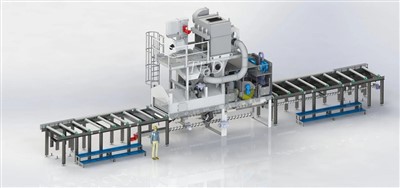
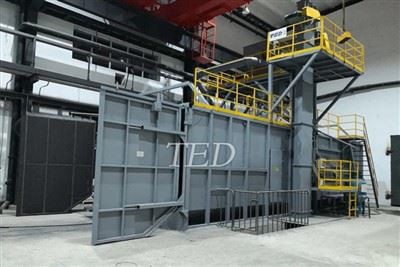
![Automatic Abrasive Recycling Sand Blasting Room]() Automatic Abrasive Recycling Sand Blasting RoomThe TED sand blasting room with automatic reclaim of the abrasive material can operate with any type of abrasive material, such as, for example, carbon steel grit, stainless steel grit, micro glass spheres, aluminum oxide, plastic...view more
-
![Sand Blasting Machine]() Sand Blasting MachineSand blasting machine Sand blast machine are mainly used to clean bigger components on site,like steel structure,big tank body,big tanks,vessel repair,pipe rust removing at oil field,containerrenew,etc.,and generally used in open , or...view more
-
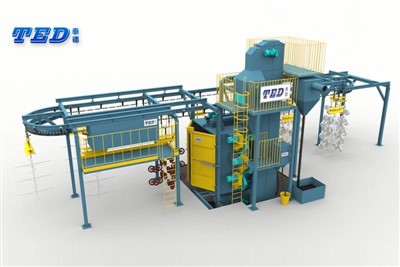
![Sandblasting Room]() Sandblasting RoomA 3D design of a three-station turntable full-automatic sandblasting machine designed for stainless steel spiral case products automatic sandblasting equipment, to meet the specific process requirements of the casting cavity and design...view more


Types and Configurations
Suction (Siphon) Cabinets:
Venturi-action systems pulling media via compressed air vacuum; suitable for light-to-medium duty cleaning, etching, and low-volume maintenance.
Direct Pressure Systems:
Pressure vessel pressurized prior to discharge; delivers higher particle velocity (up to 50 percent faster cleaning rates) for heavy rust, thick coatings, and structural steel preparation.
Wet Blasting Machines:
Slurry-based systems mixing water and abrasive; eliminates airborne dust, reduces frictional heat on thin metals, and prevents flash rusting during processing.
Automated and Custom Blast Rooms:
Enclosed structural facilities equipped with mechanical or pneumatic media recovery floors, bucket elevators, air wash separators, and multi-axis nozzle manipulators, fully supported by specialized multi-voltage electrical integration (such as 380V/50Hz, 400V/50Hz, and 480V/60Hz configurations) and automated PLC programming for seamless factory automation lines.
Working Principle and Process
Compressed air enters the system through moisture separators and regulators. In pressure systems, air pressurizes the blast pot, forcing media through a precision metering valve into the air stream. The air-media mixture travels through heavy-duty static-dissipating hose and exits a Venturi nozzle at velocities exceeding 450 miles per hour. Spent media, dust, and debris are drawn into a reverse-pulse cartridge dust collector through cyclonic separation, routing reusable media back to the hopper while discharging fine particulate.

Tungsten Carbide and Boron Carbide Nozzles: High-wear internal liners rated for 500 plus hours of continuous operation with aggressive abrasives like aluminum oxide or silicon carbide.
Pneumatic Deadman Remote Controls: Dual-line control handle providing instant shut-off of abrasive and air supply upon operator release, complying with industrial safety standards.
Pneumatic Media Metering Valves: Micro-valve design maintaining consistent, pulsing-free abrasive flow for fine abrasives (glass bead) and heavy grits (steel shot).
Reverse-Pulse Dust Collectors: Automated timer-activated compressed air blasts clearing filter cartridges to maintain constant static pressure and airflow through the cabinet.
Technical Specifications
|
Specification |
Suction Cabinet Model |
Direct Pressure Model |
Automated Room System |
|
Working Pressure |
40 to 80 PSI (2.7 to 5.5 bar) |
80 to 110 PSI (5.5 to 7.6 bar) |
90 to 120 PSI (6.2 to 8.3 bar) |
|
Air Consumption |
25 to 45 CFM at 80 PSI |
90 to 150 CFM at 100 PSI |
300 to 800+ CFM |
|
Nozzle Orifice Size |
5/16 in to 3/8 in |
3/8 in to 1/2 in |
Multi-nozzle arrays (1/2 in) |
|
Vessel Capacity |
Suction hopper |
2.0 cu. ft. to 6.0 cu. ft. |
10 to 40 cu. ft. bulk pots |
|
Dust Collector Flow |
400 CFM (Single cartridge) |
900 CFM (Dual cartridge) |
3,000 to 10,000 CFM modular |
|
Electrical Supply |
230V/1Ph/60Hz or 220V/50Hz |
460V/3Ph/60Hz or 380V/50Hz |
Multi-voltage custom (380V to 480V) |
Applications
Aerospace:
Removal of thermal barrier coatings from turbine blades and surface preparation prior to non-destructive testing (NDT).
Automotive and Powertrain:
Deburring cast aluminum engine blocks, cleaning transmission housings, and texturing brake components.
Structural Steel:
Stripping heavy mill scale, rust, and old paint on structural beams to achieve a near-white metal surface profile.
Additive Manufacturing:
Removing residual powder from 3D-printed metal components (Titanium, Inconel, Stainless Steel) without dimensional distortion.
Manufacturing and Quality Control
Vessel Fabrication:
Pressure vessels constructed from heavy-gauge industrial carbon steel plate, welded by certified technicians holding recognized pressure vessel welding credentials.
Nondestructive Testing (NDT):
Seam radiography and ultrasonic testing (UT) performed on pressure containment welds prior to structural pressure testing at 1.5 times maximum allowable working pressure.
Surface Preparation and Coating:
Internal and external steel surfaces blast-cleaned to high international cleanliness standards, followed by electrostatic application of industrial-grade polyurethane enamel.
Electrical Compliance:
Control panels built using industrial-grade enclosures (NEMA 12 / IP54 minimum) and labeled copper wiring, supporting both North American (60Hz) and international (50Hz) regional grids.
Integration of robotic arms or custom part-rotation fixtures for high-volume production lines.
Special chamber dimensions and load-bearing capacities for oversized workpieces (up to 10,000 lbs turntable rating).
Integration of specialized media recycling systems for strict abrasive segregation (ferrous versus non-ferrous processing to prevent cross-contamination).

Selection Guide
Determine Substrate Material:
Use softer abrasives (glass bead, agricultural media, walnut shell) on thin aluminum or plastics to avoid warping; use hard abrasives (aluminum oxide, steel grit) on thick carbon steel or forged iron.
Calculate Air Compressor Output:
Ensure the facility air compressor delivers at least 20 percent higher CFM than the machine combined nozzle and pulse-jet requirements at the operating pressure.
Select Delivery Method:
Specify suction units for intermittent cleaning and light deburring; choose direct pressure systems for production environments requiring high surface profiling speeds.
FAQ
As one of the leading sand blasting machine manufacturers and suppliers in China, we offer a wide range of products with superior quality. Please feel free to buy advanced sand blasting machine for sale here from our factory. Good service and punctual delivery are available.
Sand Blasting Machine